
In today’s fast-paced digital world, search engine marketing (SEM) has become one of the most effective ways for businesses to reach their audience online. Whether you’re a startup, an established company, or a marketing professional, understanding how SEM works can dramatically boost your online visibility and revenue.
Search engine marketing refers to the strategy of promoting websites through paid advertising on search engines like Google and Bing. When done correctly, it can help your business appear right where potential customers are already looking — on the search results page.
In this comprehensive guide, you’ll learn what search engine marketing is, how it works, the key tools and strategies behind it, and how to build successful SEM campaigns that drive real results.
What Is Search Engine Marketing?
Search engine marketing (SEM) is a digital marketing technique that involves using paid advertisements to appear in search engine results. These ads typically show up above or beside organic results when users type specific keywords into search engines.
Unlike SEO (Search Engine Optimization), which focuses on organic traffic, SEM is based on paid visibility — where advertisers bid on keywords to display their ads to relevant audiences.
Key Characteristics of SEM
- Pay-Per-Click (PPC): Advertisers only pay when users click on their ad.
- Keyword Targeting: Ads are shown based on user search intent and keyword relevance.
- Ad Auction System: Search engines decide which ads appear based on bid amount and ad quality.
- Instant Results: SEM campaigns can drive traffic as soon as they go live.
Why SEM Matters
Search engine marketing allows you to appear at the top of search results immediately, even if your website is new. It’s one of the fastest ways to reach customers, test marketing messages, and drive measurable ROI.
Search Engine Marketing vs. Search Engine Optimization
While both SEM and SEO aim to increase website visibility, their methods are quite different.
FeatureSEM (Search Engine Marketing)SEO (Search Engine Optimization)ApproachPaid advertisingOrganic optimizationSpeedImmediate resultsTakes time to buildCostPay per clickNo direct cost per clickPlacementSponsored listingsOrganic listingsControlFull control over ad targetingLimited control (algorithm-dependent)MeasurabilityHighly measurable via ad platformsMeasurable via analytics tools
In short, SEO is a long-term growth strategy, while SEM is a short-term performance booster. Smart marketers often combine both for maximum impact.
How Search Engine Marketing Works
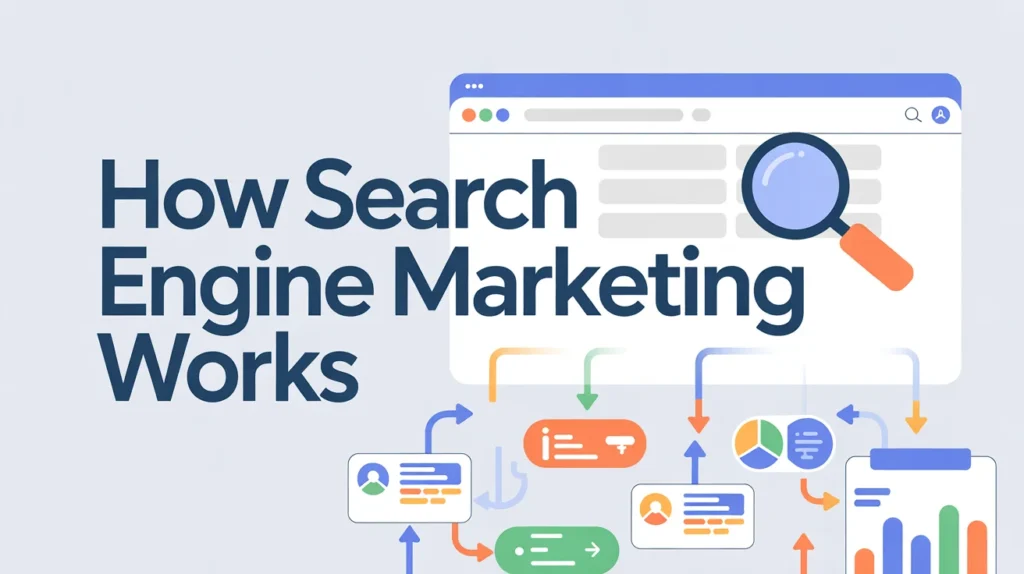
To understand SEM, you need to know how search engines decide which ads appear and when. The process happens through ad auctions, which occur in milliseconds whenever a user performs a search.
1. Keyword Research
The foundation of every SEM campaign is keyword selection. You identify search terms users might enter when looking for your products or services. Tools like Google Keyword Planner help marketers find high-value keywords with good traffic potential.
2. Ad Auction and Bidding
When someone searches a keyword you’re targeting, your ad enters an auction. The position your ad appears in depends on your bid amount and Quality Score (which measures ad relevance and user experience).
3. Ad Rank
Search engines calculate your Ad Rank using this formula: Ad Rank = Bid × Quality Score
Even if your bid is lower than a competitor’s, a high Quality Score can secure a better ad position at a lower cost.
4. Ad Display and Click
Once your ad appears, users can click it to visit your landing page. You’re charged only when a user actually clicks — making SEM cost-effective and performance-driven.
5. Conversion Tracking
The final step is measuring results. Using tools like Google Ads Conversion Tracking, you can see how many users completed a purchase, signed up, or took another desired action.
The Main Components of a Successful SEM Campaign
A winning SEM campaign combines multiple moving parts, each contributing to overall performance.
Keyword Research and Targeting
Target the right audience by choosing commercial intent keywords (e.g., “buy running shoes online”) over informational ones (“what are the best running shoes”).
Compelling Ad Copy
Your ad must attract attention within seconds. Use strong headlines, emotional triggers, and clear calls-to-action like “Shop Now” or “Get a Free Quote.”
Landing Page Optimization
Ensure your landing page matches the promise of your ad. A high-quality landing page improves conversions and boosts your Quality Score.
Bid Strategy
You can use different bidding strategies like:
- Manual CPC (Cost per Click): Full control over your bids.
- Enhanced CPC: Lets Google adjust your bids to maximize conversions.
- Target CPA (Cost per Acquisition): Automatically sets bids to achieve your cost goal.
Ad Extensions
Add extra information to make your ads more clickable. Common extensions include:
- Sitelink Extensions: Direct links to other pages.
- Call Extensions: Adds a phone number.
- Location Extensions: Shows your business address.
Platforms for Search Engine Marketing
While Google Ads dominates the SEM space, several other platforms can also drive great results.
1. Google Ads
The most popular SEM platform, Google Ads reaches billions of users daily. It offers powerful targeting, ad customization, and performance tracking.
2. Microsoft Advertising (Bing Ads)
Bing Ads offer cheaper CPCs and access to a unique audience, especially in the U.S. and older demographics.
3. Amazon Ads
For eCommerce businesses, Amazon’s search ads are invaluable for targeting purchase-ready customers.
4. YouTube Ads
Since YouTube is owned by Google, you can run SEM video ads targeting keywords users search on the platform.
Benefits of Search Engine Marketing
Search engine marketing delivers measurable, scalable benefits for businesses of all sizes.
- Instant Visibility: Unlike SEO, SEM puts you at the top of search results immediately.
- Highly Targeted: Ads appear only for relevant audiences based on keywords, location, and demographics.
- Flexible Budgeting: You control your daily spend and can adjust at any time.
- Data-Driven Insights: Every click and conversion is measurable, allowing continuous optimization.
- Competitive Edge: Stay visible even in competitive markets where organic ranking is tough.
Best Practices for Effective Search Engine Marketing
To get the best ROI, follow these proven SEM best practices:
- Start with Clear Goals: Define whether you want traffic, leads, or sales.
- Use Long-Tail Keywords: These are less competitive and more conversion-focused.
- Optimize for Mobile: Over 60% of SEM clicks come from mobile devices.
- A/B Test Your Ads: Experiment with different headlines and calls-to-action.
- Monitor and Adjust: Use analytics tools to refine your strategy regularly.
Common Mistakes to Avoid
Even experienced marketers make these SEM errors that can waste budget and reduce performance:
- Targeting too many broad keywords.
- Ignoring negative keywords.
- Linking to irrelevant landing pages.
- Not tracking conversions.
- Overbidding without testing Quality Score improvements.
Avoiding these mistakes ensures your campaigns remain cost-effective and performance-driven.
Real-World Example: SEM in Action
Imagine a small online shoe retailer launching a new line of running shoes. Through Google Ads, they target keywords like “best running shoes 2025” and “buy athletic shoes online.”
They create two ad versions:
- One highlights “Free Shipping and Returns.”
- The other emphasizes “20% Off Your First Order.”
By analyzing which ad gets more clicks and conversions, the business learns what drives real results — and can scale that strategy further.
This simple example shows how SEM allows real-time testing and data-driven decision-making.
Future Trends in Search Engine Marketing
The future of SEM is evolving rapidly. As search engines and user behavior change, marketers must adapt.
1. Artificial Intelligence (AI)
AI-powered bidding and predictive analytics help automate campaign optimization.
2. Voice Search
More users are searching using voice assistants, meaning keyword strategies will shift toward conversational phrases.
3. Visual and Video Ads
Visual search and video-based ads will become more dominant on Google and YouTube.
4. Privacy and Data Protection
Stricter data laws mean advertisers must rely more on first-party data and consent-based targeting.
FAQs About Search Engine Marketing
1. What is search engine marketing in simple terms? Search engine marketing (SEM) is the process of using paid ads to appear in search results when people look for products or services online.
2. How is SEM different from SEO? SEO improves organic rankings through content and optimization, while SEM uses paid ads to gain immediate visibility.
3. What are examples of search engine marketing? Examples include Google Ads, Bing Ads, and Amazon sponsored product listings.
4. Is search engine marketing expensive? The cost depends on keyword competition and budget, but SEM can be adjusted to fit small or large campaigns.
5. What are the benefits of SEM for small businesses? It helps small businesses compete with larger brands by giving them instant visibility and measurable results.
Conclusion
Search engine marketing remains one of the most powerful digital strategies for driving visibility, traffic, and conversions. By mastering keyword targeting, ad copywriting, and campaign optimization, businesses can ensure they reach customers at the perfect moment — when they’re ready to take action.
In 2025 and beyond, SEM will continue evolving with AI and automation, but its core principle remains the same: delivering the right message to the right audience at the right time.