
The Xbox Series X review continues to stand as one of the most important benchmarks in console engineering. Since its launch, Microsoft’s flagship system has represented the company’s vision of combining PC-grade performance with the accessibility of console gaming. In this review, we’ll take an in-depth look at how the Series X performs under real-world conditions, from frame rates and load times to ecosystem integration and developer support.
For tech-savvy gamers, the Xbox Series X isn’t just another console — it’s a statement on how architecture and optimization can redefine what’s possible in the living room.
From Xbox One X to Xbox Series X The Evolution of Microsoft’s Flagship Console
To understand the Xbox Series X, it’s worth recalling how far Microsoft’s console design has come. The Xbox One X, released in 2017, was marketed as the world’s most powerful console of its generation, pushing native 4K gaming and HDR. However, it was still built on older CPU architecture, which limited its frame rate potential and efficiency.
The Series X, introduced in late 2020, marks a complete redesign from the ground up. It’s built on AMD’s Zen 2 CPU and RDNA 2 GPU, featuring modern architecture similar to that found in custom gaming PCs. Combined with a lightning-fast NVMe SSD, the Series X delivers consistent high performance while drastically reducing load times.
This generational leap showcases Microsoft’s focus on performance per watt, developer-friendly architecture, and forward compatibility through technologies like Smart Delivery and Game Pass integration.
Design and Build Quality

The Xbox Series X takes a minimalist, tower-like design — a deliberate shift from the flatter, angular shapes of previous consoles. Its rectangular form resembles a small PC tower, allowing efficient vertical airflow.
- Dimensions: 301mm x 151mm x 151mm
- Weight: Approx. 4.45 kg
- Cooling System: A single large fan and vapor chamber system
The matte black chassis is understated but premium, emphasizing thermodynamic efficiency rather than visual flair. The power button retains the classic Xbox emblem, and the front-facing USB port is conveniently placed for quick access.
Thermally, the Series X excels. The vapor chamber and custom heatsink distribute heat evenly, while the top-vented design ensures quiet operation even under heavy load. Measured noise levels typically stay below 30 dB, making it one of the quietest high-performance consoles ever built.
Hardware Specifications and Architecture
At the core of the Xbox Series X lies a custom AMD SoC combining an 8-core Zen 2 CPU with an RDNA 2 GPU. Here’s a breakdown of its technical specifications:
ComponentSpecificationCPU8-Core AMD Zen 2 @ 3.8 GHz (3.6 GHz with SMT)GPUAMD RDNA 2, 12 TFLOPS, 52 CUs @ 1.825 GHzMemory16GB GDDR6 (10GB @ 560 GB/s + 6GB @ 336 GB/s)Storage1TB NVMe SSD (Custom Xbox Velocity Architecture)Expandable Storage1TB Seagate Expansion Card (PCIe 4.0)Optical Drive4K UHD Blu-rayVideo Output4K @ 120Hz, 8K Ready
This hardware allows the Series X to deliver seamless 4K gaming at up to 120 frames per second, with variable refresh rate (VRR) and auto low-latency mode (ALLM) for responsive gameplay.
The real star here is Microsoft’s Velocity Architecture, combining custom NVMe SSD storage with dedicated decompression hardware. This system drastically improves texture streaming, asset loading, and resume speed between multiple games — something even high-end PCs often struggle to replicate in such a streamlined way.
Performance and Real-World Gaming Benchmarks
In practice, the Xbox Series X maintains exceptionally stable performance across modern titles. Optimized games like Forza Horizon 5, Halo Infinite, and Cyberpunk 2077 (Next-Gen) consistently reach or exceed 60fps in 4K, with select titles pushing up to 120fps on supported displays.
Load times average between 5–10 seconds for large open-world titles — roughly four times faster than the Xbox One X. Game switching using Quick Resume is nearly instantaneous, allowing users to toggle between multiple active sessions in seconds.
Ray tracing performance is impressive for a console, though it doesn’t match mid-to-high-tier PC GPUs. However, its balanced combination of resolution, frame rate, and effects quality provides an optimized experience rarely seen on fixed hardware platforms.
Comparison Table Xbox Series X vs PS5 vs High-End PC
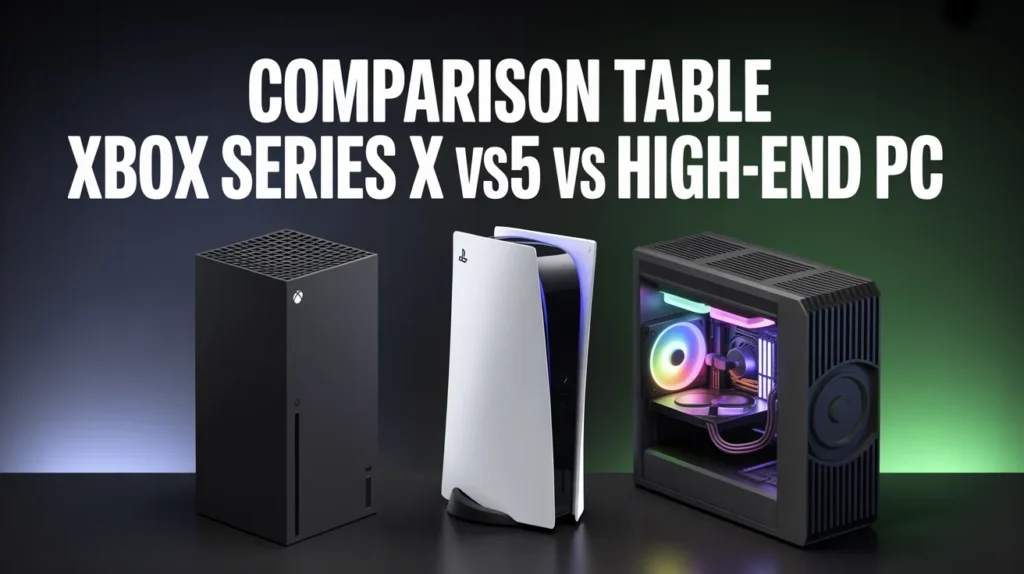
FeatureXbox Series XPS5High-End PC (RTX 4070, Ryzen 7)CPUAMD Zen 2, 8-core @ 3.8 GHzAMD Zen 2, 8-core @ 3.5 GHzAMD Zen 4, 8-core @ 4.5 GHzGPU12 TFLOPS, RDNA 210.3 TFLOPS, RDNA 229 TFLOPS, Ada LovelaceMemory16GB GDDR616GB GDDR632GB DDR5Storage1TB NVMe (Custom)825GB NVMe (Custom)2TB PCIe 4.0 NVMeResolution4K @ 120Hz, 8K Ready4K @ 120Hz, 8K Ready4K–8K (Varies)Price (2025)$499$499$1,500+
While the PC outperforms both consoles in raw power, the Xbox Series X holds a strong position in value-to-performance ratio, delivering consistent frame rates and fidelity at a fraction of PC cost.
Backward Compatibility and Ecosystem Integration
Microsoft’s approach to backward compatibility is one of the strongest in the industry. Nearly all Xbox One, Xbox 360, and select original Xbox titles run on the Series X — often with enhanced frame rates, auto HDR, and improved textures.
The Xbox Game Pass Ultimate ecosystem ties it all together. It provides subscription-based access to hundreds of titles, cloud saves, and Xbox Cloud Gaming, which allows streaming to PCs and mobile devices. Combined with Smart Delivery, the Series X automatically installs the best version of any purchased game based on the hardware.
Peripheral support is also excellent. Previous-generation controllers, headsets, and external drives remain compatible, ensuring a seamless upgrade path for long-time Xbox users.
Multimedia and Entertainment Features
Beyond gaming, the Series X functions as a robust media hub. The integrated 4K UHD Blu-ray drive, Dolby Vision, and Dolby Atmos support make it ideal for high-quality entertainment playback.
It supports all major streaming apps, including Netflix, Disney+, Amazon Prime Video, and YouTube, all in 4K HDR. HDMI 2.1 connectivity ensures minimal latency when connected to modern TVs and receivers, supporting automatic low-latency mode switching for both gaming and streaming.
Developer Optimization and Software Ecosystem
Microsoft’s consistent developer tools, including DirectX 12 Ultimate and Game Development Kit (GDK), provide a unified platform for game creators. This ensures that games run efficiently across both Xbox Series consoles and Windows PCs.
The DirectStorage API, part of the Velocity Architecture, allows for faster data streaming directly from SSD to GPU. This eliminates traditional bottlenecks in asset loading, creating near-instant world rendering in open-world titles.
The combination of these tools and cross-platform development support has allowed developers to deliver optimized experiences without complex porting challenges.
Pros and Cons
ProsConsExceptional 4K performanceLimited exclusive titlesWhisper-quiet coolingBulky vertical design may not fit all spacesFast load times via Velocity ArchitectureUI occasionally sluggishExcellent backward compatibilityNo major UI overhaul from Xbox OneAffordable compared to high-end PCsSome third-party storage options are costly
FAQs
1. Is the Xbox Series X worth upgrading from Xbox One X? Yes, especially if you value performance, faster load times, and higher frame rates. The jump from HDD to NVMe SSD alone significantly improves responsiveness.
2. Does the Xbox Series X support 8K gaming? It is 8K-ready, meaning it can output 8K for select media or future games, though most current titles are optimized for 4K.
3. How quiet is the Xbox Series X during heavy gameplay? The advanced vapor chamber cooling keeps noise levels under 30 dB even during graphically intense sessions — virtually silent for most users.
4. Can the Xbox Series X use external storage for games? Yes, via USB 3.1 drives for backward-compatible titles and the proprietary Seagate Expansion Card for Series X|S games.
5. What sets the Series X apart from the PS5 for tech users? The Series X provides slightly higher GPU power, more efficient cooling, and a more versatile ecosystem that integrates with Windows PCs and Game Pass.
Conclusion
The Xbox Series X remains one of the most technically impressive consoles ever built. Its combination of raw power, efficient architecture, and deep ecosystem integration makes it a model of console engineering.
For tech-savvy gamers, this console represents the sweet spot between affordability and performance. While it doesn’t entirely replace the flexibility of a high-end PC, it comes impressively close — offering 4K gaming, fast load times, and quiet operation in a compact, reliable form.